
Last updated: 2026-02-03
“These are my principles, and if you don’t like them… well, I have others.” — Groucho Marx
A Principal Product Manager is the most senior individual contributor (IC) role on a product management career ladder. Unlike a Group PM or Director of Product, a Principal PM doesn’t manage other PMs. Instead, they create outsized impact through deep expertise, strategic influence, and hands-on ownership of a product area whose outcomes ripple across the organisation.
The role has grown in prevalence as more companies adopt dual-track career paths for product managers—but what it actually means in practice is still poorly understood. Having traveled this path myself and seen it play out across multiple companies, I’ve distilled my view of the Principal PM to three pillars:
- outsized positive impact to multiple product areas and/or the Product function;
- applying one’s unique experience and skills;
- in a cross-functional team dedicated to a product area.
The rest of this post unpacks each of these.
Career paths for Product Managers
Traditional (single-track)
As in other disciplines, career progression for Product Managers has been traditionally tied to becoming a people leader / manager.

This relies on the assumption that folks who are great at managing products will be great at managing people—stifling the ability for folks who don’t fit in this assumption to grow their impact, their career, and their income.
Dual-track career path: the birth of the Principal Product Manager
Following a similar trend in (most notably) Engineering, companies have started adopting dual-track career paths for Product Managers. The traditional management track is complemented with a parallel track of individual contributor levels, which intend to represent a comparable growth in impact and compensation—but without the ultimatum to become a people manager. Here’s a few prototypical examples of such career ladders.
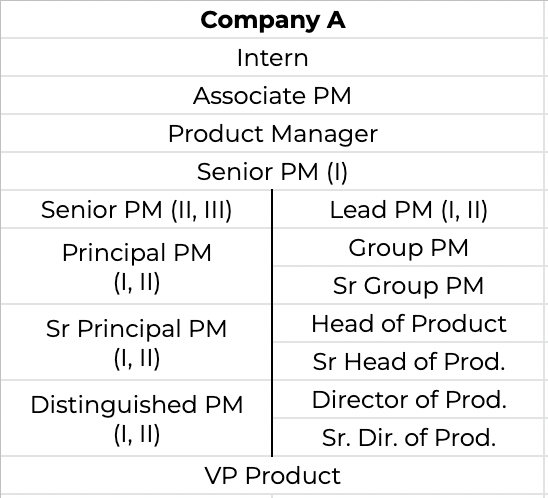


The Group PM often shows up as the first level in the management track, with most companies seeing it as a player-coach role. A Group PM will oversee a group of 2-3 product areas by being the line manager for 1-2 PMs and being the individual contributor PM for one of those areas. This allows them to ease in to people management—a gateway drug, if you will.
Another common trait of dual-track career paths I’ve seen is for the two tracks to converge again towards VP Product and/or CPO. This is coherent with the philosophy of no track being intrinsically better than the other. However, I haven’t seen it play out like this in practice for the individual contributor track.
Principal Product Manager vs. Group Product Manager
Since both roles sit at a similar level of seniority, the distinction is worth making explicit:
| Principal PM | Group PM | |
| Track | Individual contributor | Management |
| Direct reports | None | 1–3 PMs |
| Scope | One product area with cross-cutting impact | Multiple product areas via team oversight |
| Leverage | Deep expertise and influence | People management and coordination |
| Compensation | Comparable to Director-level | Comparable to Director-level |
The choice between the two tracks should reflect the individual’s strengths and preferences—not a hierarchy of prestige. In practice, the Principal Product Manager path suits those who want to stay close to the product and create impact through craft, not through org charts.
How Principal PMs create outsized impact
Cross-functional team
Being in a cross-functional team is core to the multiplicative impact of a Staff or Principal Product Manager. They still channel their efforts mostly to one product area, but with that they produce outcomes that impact multiple ones. I personally don’t subscribe to the notion that a Staff or Product Manager’s superpower is a particular ability to individually PM multiple product areas at once.
This is without detriment of mentoring other PMs (formally or informally) or otherwise contributing to the product management practice at the company.
Product areas that lend themselves to outsized impact
The Staff or Principal Product Manager leads a product area that lends itself to this value multiplier effect. From experience, some particularly good candidate areas for this include:
- foundations like authentication/authorization, design system, product analytics and experimentation;
- ecosystem (integrations with complementary products popular among customers and/or Public API for those complementary products to integrate with);
- cross-vertical capabilities, like payments / billing / invoicing;
- taking the product to new avenues that are fundamentally different from current ones—e.g. a new business model (like a platform business), or building the first mobile app for a mature web-based product.
Unique skills and experience of a Principal Product Manager
The fact that the product area lends itself to an outsized impact isn’t enough—the PM needs to be individually set out for success in this particular product area.
Let’s start with skills / experience tied to the particular problem domain (or even solution domain). The best Staff / Principal PMs I’ve seen in action are deeply knowledgeable and/or experienced on the particular UX and/or Tech and/or Business contours of the product area they lead. On the “experienced” angle, it’s worth caveating around the pitfalls of hiring someone who’s done it before:
- exposure to working in the problem/solution domain multiple times, at different types of company and even in different roles, is way more crucial than having done once the exact same thing they’re expected to pull off now;
- with this experience, the PM shouldn’t be expected to bring all the answers, but rather to have seen enough to be able to ask the right questions.
There are a few other more generic skills and traits that, albeit important for any PM, a Staff of Principal PM must excel at to succeed in a niche scope that impacts multiple other product areas.
Looking at product problems from multiple zoom levels
They’re able to bounce from trees to forest and back. Able to understand, abstract and connect the multiple disparate problem areas they’ll have an impact on.
Influencing
Because their work will often depend on, have an impact on, or need to be adopted by other product areas. Be ready for tough conversation on trying to influence others’ roadmaps!
Articulating and communicating value
Not only to unlock the kind of influencing we’ve just seen, but also because they can’t rely on stakeholders intuitively “seeing” the business value of what they do in the same they as when they look at a user-facing feature’s mockup.
Planning
Not Gantt and deadlines, but what’s the sequence of events that need to happen, in and around one’s product area, for one’s contributions to be adopted. They need to be excellent iterators, so the adoption of their team’s efforts can happen progressively—instead of being dependent on everyone being ready to switch on an exact Flag Day.
The Principal Product Manager archetype
My understanding is that the most successful Staff or Principal PMs I’ve seen in action throughout multiple companies:
- had an outsized positive impact to multiple product areas and/or the Product function;
- by applying one’s unique experience and skills;
- in a cross-functional team dedicated to one product area.
The role isn’t about being a “super-Senior PM” who does the same job with more seniority. It’s a qualitatively different way of creating impact—through depth, influence, and choosing the right leverage point in the product.
I’m still traveling this path myself, so time will tell whether this view holds water and how it evolves.
This post represents my individual professional opinion on this subject, not that of any company I work (or have worked) at/for on this subject area.